World Bank Revised Indonesia Economic Growth Target


.jpg)
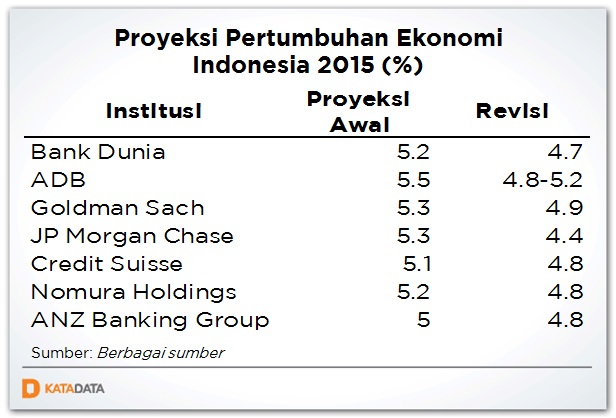
KATADATA ? The harsh projection over Indonesia?s economy this year keeps on being delivered by the international financial institute. After the Asian Development Bank (ADB) has decreased the economic projection of Indonesia, the same step is also being taken by the World Bank.
World Bank has projected Indonesia?s economic growth this year to only be at 4.7% from before, which was at 5.2%. The reason is because World Bank sees that the support from fiscal sector is still low to boost the economic growth. There are two fiscal posts that are being looked at as the cause for the slow economic growth, which are the country?s absorption which is still in a minimum level, and also the low level of expenditure realization.
The Head Representative of World Bank for Indonesia, Rodrigo A. Chaves, said that the success of the government to reach a higher economic growth and its continuity depends on the development of infrastructure. Besides that, Indonesia need to fix the atmosphere of business to attract investors from the private sectors. ?It needs a precise priority scale and a continuity from the key reformation, especially to strengthen the fiscal sector and to increase the investment,? said Rodrigo in a World Bank event ?Indonesia Economic Quarterly? in Jakarta, Wednesday (8/7).
Therefore, World Bank suggested to develop the infrastructure to help boost the economy. But the consequence would be an increase in the fiscal deficit from the current number by 1.9% against the Gross Domestic Product (GDP). However, the deficit must be kept to stay below 3% against the GDP.
Ndiame Diop, World Bank?s Main Economist, added that the slow economic growth has affected the average expenditure of household sectors, which is also declining even though the percentage is still at 55% against the GDP?s expense. The condition initially started when the government?s tax absorption was decreasing.
On the other side, export is also declining since the economy of China is weakening. In Diop?s note, the export commodity to China during the period 2004 ? 2011 could grow up until 31.5%. However in 2014, the export to the country fell to 25% only.
Another factor that contributes to the cause of the slow economic growth is the decline in investment by 50% compared to 2012. The decline during the first semester of this year is a big factor that pressures the economic growth in Indonesia. ?Since the commodity is slowing, then this would affect the economy. The fact is that this would affect the workers as well,? explained Diop.
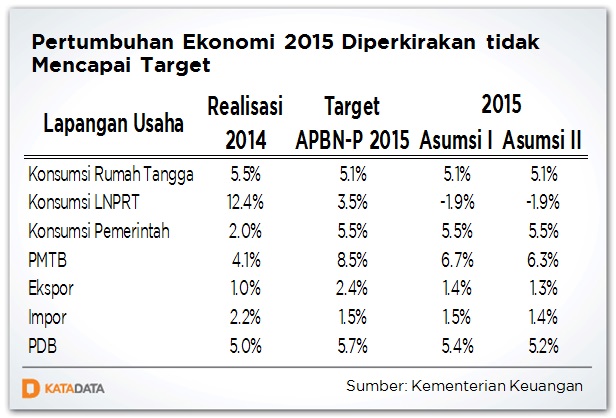
Previously the government and Bank Indonesia have also lowered the projection of economic growth for this year. Both institutions are not sure that the target for the economic growth in the State?s Budget 2015, which is at 5.7%, is able to be reached.
The Minister of Finance, Bambang Brodjonegoro, predicted that the economy would grow at around 5.2% to 5.4%. To reach the target, then the government need to boost the expenditure of the state, especially to fund the infrastructure development. He is also optimist that the state?s expenditure will increase in the second semester this year.
This revision is made based on the export performance that is still being predicted to be low since other commodity price depreciates as well. Furthermore, the government investment, which was hoped to be able to halt the fall of the household?s expenditure and also in the private investment sector, did not increase on the last second quarter.
Dapatkan pengalaman membaca lebih nyaman dan nikmati fitur menarik lainnya lewat aplikasi mobile Katadata.